
ZX Spectrum+ 128K
Introduction
The ZX Spectrum+ 128K was the most substantial development of the Spectrum carried out by Sinclair Research. It doubled the memory of the 48K Spectrum, added a much more capable sound chip, introduced a new version of Sinclair BASIC and provided a number of facilities designed to make practical use of the additional memory.
Although the machine retained the familiar Spectrum architecture and remained compatible with the enormous existing software library, the 128K represented a significant expansion of the original design. It was also the first Spectrum to introduce features that would become important to the later development of the machine under Amstrad.
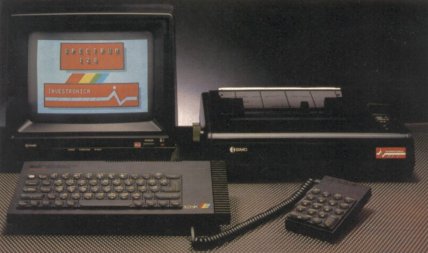
The machine was developed jointly by Sinclair Research and its Spanish distributor, Investrónica, under the project name Derby. The Spanish version was launched in September 1985, followed by the UK version in January 1986.
The Spanish connection
Spain was an important market for Sinclair, and Investrónica had become closely involved with the company's operations there. The Spanish market also had particular regulatory requirements, including the need for computers to support the Spanish language.
The development of the 128K therefore involved both Sinclair Research and Investrónica. Much of the engineering work was carried out in Cambridge, while the Spanish distributor contributed to the development and production of the Spanish version.
The Spanish launch came before the UK release, allowing Sinclair to introduce the new machine in an important market before bringing it to Britain. The Spanish machine also differed in a number of details from the later UK model, making the early Investrónica machines an interesting part of the history of the 128K Spectrum.
Design
The industrial design of the ZX Spectrum+ 128K was again the work of Rick Dickinson, who had designed both the original ZX Spectrum and the ZX Spectrum+.
The case was based closely on the ZX Spectrum+ design, retaining its full-size moulded keyboard and sloping profile. The raised ZX Spectrum+ logo remained on the case, with 128K added alongside it.
The most obvious external change was the large heatsink mounted on the right side of the case. Its distinctive appearance quickly led to the machine being nicknamed the "Toastrack".
The tape connections were moved to the left side of the machine. The rear gained an RGB connector for connection to a suitable monitor, while a combined serial and MIDI interface was provided using a telephone-style connector.
A separate numeric keypad could be connected to a socket on the front of the computer. This provided additional editing, cursor and calculator facilities when the machine was being used in its new 128K environment.
Hardware
At the heart of the ZX Spectrum+ 128K was a Zilog Z80A processor running at approximately 3.55 MHz. The processor was essentially the same as that used in earlier Spectrums, but the surrounding hardware was considerably expanded.
The machine contained 128K of RAM, arranged as eight 16K banks, together with 32K of ROM. One ROM contained the original Spectrum software used by the 48K environment, while the second contained the new 128K system software.
The display remained the familiar Spectrum display of 256 by 192 pixels, with colour attributes assigned to 8 by 8 pixel character cells. The additional memory did not introduce a new graphics mode, but it allowed additional screens and graphics data to be stored outside the normal 48K address space.
The most important hardware addition was the AY-3-8912 programmable sound generator. This provided three independent sound channels, together with noise generation and envelope facilities.
The original Spectrum's small internal speaker was no longer used in the same way. Sound from the AY chip, together with the Spectrum's traditional BEEP output, was routed through the television and audio connections.
The expansion connector remained part of the Spectrum's hardware, although the new circuitry and different power-up behaviour could cause compatibility problems with some older peripherals.
The 128K Environment
When switched on, the ZX Spectrum+ 128K started in its new 128K environment. This introduced a number of changes to the way BASIC programs were entered and edited.
The familiar single-keypress keyword system of the original Spectrum was replaced by a conventional screen editor. BASIC keywords could now be typed in full rather than being entered using the original keyword-entry system.
The editor provided cursor movement and editing facilities, allowing a program to be examined and changed directly on the screen. This was a considerable improvement over the relatively primitive editing facilities of the original Spectrum BASIC.
BASIC continued to perform syntax checking as lines were entered. Errors could be identified on the screen, while the new editor made it easier to correct mistakes without repeatedly re-entering an entire line.
The original Spectrum BASIC environment was still available. Entering the SPECTRUM command switched the computer into its 48K-compatible environment, allowing software written for the original Spectrum to be run.
The Numeric Keypad
One of the unusual features of the original 128K package was its separate numeric keypad. Rather than building a keypad into the main computer, Sinclair supplied a separate unit which connected to the front of the Spectrum.
The keypad provided additional cursor and editing controls for the 128K environment, together with calculator-style facilities. It complemented the new screen editor and made the 128K environment considerably more practical for entering and editing programs.
The decision to keep the keypad separate allowed Sinclair to retain the familiar Spectrum+ keyboard while adding facilities that were primarily useful to users making use of the new 128K software.
Sound and PLAY
The addition of the AY-3-8912 sound chip was one of the most significant improvements introduced by the 128K.
The chip provided three independent sound channels, noise generation and envelope control. This allowed the computer to produce chords, melodies and considerably more sophisticated sound effects than were possible with the original Spectrum's one-bit beeper.
Sinclair also introduced a new BASIC command called PLAY. Music could be described using strings containing instructions for notes, octaves, durations and other musical properties, allowing considerably more sophisticated music to be produced directly from BASIC.
The new sound hardware also opened the way for richer music and sound effects in 128K software. Existing programs using the original BEEP command remained usable when running in the 48K-compatible environment.
128K Memory
The additional RAM could not simply be added to the Spectrum's existing 64K address space. The Z80A can address only 64K of memory at a time, so the 128K machine uses a system of memory paging to select which parts of its RAM are visible to the processor.
The 128K of RAM is divided into eight 16K banks. Four 16K sections make up the Z80's address space at any one time, while the paging hardware determines which RAM banks are available in the appropriate sections.
This arrangement allowed programs to keep additional data, screens, graphics, music and machine-code routines in RAM that was not currently visible in the normal 64K address space.
One of the paging controls also allows the computer to select which RAM bank is used for the display. This makes it possible for 128K software to prepare an alternative screen in memory and then switch to it.
The main paging system is controlled through the I/O port $7FFD. The port controls the selected RAM bank, the display screen and other aspects of the memory configuration.
The additional memory therefore did not simply turn the Spectrum into a computer with a larger continuous block of RAM. Software had to make deliberate use of the bank-switching system in order to take advantage of it.
The Silicon Disc
Sinclair provided a particularly interesting way of using the additional memory as a Silicon Disc.
New BASIC commands including LOAD !, SAVE ! and CAT ! could be used to store programs and data in the additional RAM. The system was similar in concept to the facilities provided by the Interface 1 and Microdrive, but the Silicon Disc was entirely electronic and therefore considerably faster than cassette or Microdrive storage.
The Silicon Disc was particularly useful for programs that needed to work with more data than could conveniently be kept in the normal 48K memory area. Data and machine-code routines could also be distributed between several memory banks.
Compatibility
Compatibility with the enormous existing library of Spectrum software was one of the most important considerations in the design of the 128K.
The SPECTRUM command switched the machine into its 48K-compatible environment. This provided a way for existing software to be run without requiring the programs to understand the new 128K hardware.
Software running in this environment could continue to make use of the familiar Spectrum facilities, while programs specifically written for the 128K could access the additional memory, AY sound and other new features.
The result was effectively two levels of Spectrum software. The enormous existing library remained available, while a new generation of programs could be developed specifically to exploit the capabilities of the 128K.
Some early Spanish machines also differed from later production models in details of their ROMs and hardware timing. These differences could affect certain software and tape-loading techniques, making the Spanish and UK machines an interesting subject in their own right.
128K Software
The arrival of the 128K created a new opportunity for software developers. Programs could now use additional memory for larger graphics, multiple screens, music, data and machine-code routines.
Games could also be designed specifically around the new hardware. The AY sound chip provided much richer music and effects, while memory paging allowed considerably larger programs to be constructed from sections of code and data that were swapped into the processor's address space when required.
This did not make the original 48K Spectrum obsolete. Instead, the 128K extended the Spectrum platform while retaining access to its existing software library.
The Last Sinclair Spectrum
The ZX Spectrum+ 128K was the final Spectrum developed under Sinclair Research. It represented the point at which the original Spectrum architecture was extended as far as Sinclair was prepared to take it, adding memory, improved sound and a more sophisticated programming environment while retaining the compatibility that had helped make the Spectrum successful.
The machine would soon become an important link between the Sinclair and Amstrad generations of the Spectrum. When Amstrad acquired Sinclair's computer business in 1986, the 128K hardware formed the basis for the next generation of Spectrum computers, beginning with the ZX Spectrum +2.
Technical Specification
| Processor | Zilog Z80A at approximately 3.55 MHz |
|---|---|
| RAM | 128K, arranged as eight 16K banks |
| ROM | 32K |
| Display | 256 × 192 pixels with Spectrum colour attributes |
| Sound | AY-3-8912 three-channel programmable sound generator |
| Keyboard | ZX Spectrum+ full-size keyboard |
| Numeric keypad | Separate external keypad |
| Storage | External cassette recorder |
| Video | RF television output and RGB monitor connection |
| Expansion | ZX Spectrum expansion connector |
| Memory paging | I/O port $7FFD |
Summary
The ZX Spectrum+ 128K was much more than a Spectrum with extra memory. Sinclair expanded the original design with a sophisticated bank-switched memory system, a three-channel sound generator, new BASIC facilities, a screen editor and the Silicon Disc, while still providing a route to the enormous library of existing 48K software.
It was also the last Spectrum developed by Sinclair Research. The 128K therefore occupies an important position in the history of the machine, standing between the original Sinclair designs and the later Amstrad Spectrum computers that would carry the name into the final years of its commercial production.